Tuesday, June 3, 2014

The reason

Our official university trip ended on Friday. Since Saturday, I have been staying at the Thắng Nghiêm pagoda, about an hour from the old city Hanoi. It's a Buddhist Temple, which my social work professor calls her spiritual home. 

It's difficult to describe being at the pagoda. Everyone told me that Vietnam was going to be hot. I was, prior to departure, frustrated that no one seemed to want to quantify that. Now I know it's because the heat here defies language. 

When we were staying in an air conditioned hotel and traveling by hatter bus, it was roughly manageable, given plenty of bottled water and rest indoors. The pagoda has no air conditioning. My first full day, this heat without respite (oscillating fans are a joke in this kind of humidity) was all I could think about. 

The second day, the pain in my legs claimed my full attention. I am sleeping on a wood frame bed with a simple straw mat--no mattress. During prayers and meals we sit cross-legged, except when we kneel for prostrations. My American desk-sitting hips are too tight for this posture, so my legs fall asleep quickly, my knees feel wrenched out of place, and most of my weight rests on my ankle bones, which are badly bruised. 

Today, I am thinking of companionship. 


My friend, Nhi (pronounced "knee"), is a brilliant artist that lives at the pagoda with her son, Dim (pronounced "zeem"). She saved me from a dizzy spell this morning with a scalp massage. She has been teaching me prayers in Vietnamese piece by piece. Right now, I am sitting in the courtyard of her 100-year old home, eating peanuts and watermelon, playing with her tiny dog, Bee, watching her husband paint an oil landscape of a Vietnamese village. It's cooler here somehow, surrounded by old stones. But that hardly matters. Now she is asking me to explain when to use the phrase "o'clock" and when "am/pm." 

These moments are the reason I travel. 

Wednesday, May 28, 2014

Week's Summary

I really had intentioned to write daily, but I don't think anything could have prepared me for how overwhelming the heat would have been this week, how flying to Europe is no preparation for the jet lag you experience in Asia, how I would want to soak in every moment until I was so completely exhausted that typing is torture. So, here is just a brief rundown of things I've seen, much of which I will revisit in my hopefully more frequent posts this week. 

Monday, At Vietnam National University, we discussed the historical and geographical factors that have led to Vietnam's uniquely blended culture. We explored religious expression as one example of that blending.
We also learned about the development of social work as a profession, and the different governmental structure that makes the process of training social workers (from a western point of view) challenging. 

We visited service centers, including a day school for children with autism on Tuesday. Although a hot topic in the states right now, autism is just beginning to be understood in Vietnam, and services are limited. Yet, I was struck by the similarity in educational approaches being practiced here and what I learned in the states as a teacher's aide. 

Wednesday, At the Ministry of Labor, Invalids, and Social Affairs (MOLISA) we got more information about governmental structure and approach to social problems. 

Thursday, we visited Maihung Day Psychiatric Hospital, a community-based agency that serves individuals with mental illness that does not cause them to be considered a threat to their community. The most common diagnoses they see are schizophrenia, emotional disruption caused by stress, and addiction. Vietnam is in the process of moving toward universal health care, but I found it interesting that for now, psychiatric treatment for people with schizophrenia and epilepsy are covered by the government insurance at 100%. 

Friday, we were honored to meet the premier scholar on gender equality and domestic violence, who shared history of gender role development with us, as well as an innovative service model that was adapted from our idea of shelters (which aren't culturally applicable here). We also visited a short-term shelter for women who have left abusive relationships. 

Saturday we visited Ha Long Bay, one of the natural wonders of the world. 


And today we had a rest day before traveling to the Khuc Thuy pagoda for popsicles and, soon, dinner. 


Sunday, May 18, 2014

Arriving in Vietnam.

I just got up for my third morning in Vietnam, although it is difficult to distinguish the days at this point, which blur into a single whirlwind, yes still feels I've been here a hundred years. This will be a text-heavy post because I want to orient you back home to my new world, but bear with me and it will get smoother in the future. 

I flew from Atlanta with two members of my MSW cohort--Chelsea and Tori. Our air travel was fairly uneventful, though our luggage was left in Tokyo because there "wasn't enough room" on our non-full flight to accommodate our luggage. 😕 We arrived Friday night (which was Friday afternoon for those of you in the states--but this will be the only time I try to translate time differences, since it's usually not so relevant), and fell quickly into bed. 

We had a free day on Saturday, so after breakfast we explored a bit around our hotel, mostly looking for clothes in case our luggage didn't arrive. We realized we had booked that night in the "sister hotel" if where we would be staying with Dr. Huong Nguyen and the rest of the social work students, so we arranged for a taxi to go to the correct place. 

Once we met up with them, Anne, the student who helped Huong arrange the trip, showed us a less-touristy market where I searched high and low for sunscreen. The weather here is very hot, and the sun is brutal. Although pale skin in prized in Vietnamese culture, the women hear wear long sleeves, hoods, scarves, and hats, rather than sunscreen. I finally found a small bottle, but I paid a premium for it. 


Money is a fun adventure in and of itself. 1usd equates roughly 20,000Vietnamese Dong. I'm getting better at making conversions in my head, but sticker shock is real. Many of he vendors in this part of town speak some English to be able to convey prices, but it's inconsistent whether they tell you in Dong or Dollars, and they sometimes use the word "dollar" when it's not what they mean. For example, the first time I tried to buy a bottle of water, a woman confidently exclaimed "ten dollars!" I know it's hot here, but this shocked me so much I just walked away. Now, I've realized that people usually leave off the "thousand" in a price to save time (nothing, of course, costs less than 1,000VD) and that 10VD (50 cents) is the going rate for bottled water. 

We also went to the cell phone store. I brought with me a cell Chesley and Rachael (our dear US "landlords") have used in China in the past. But the phone has an AT&T logo, and the store here wanted to charge me 300VD to check if it had been rooted for international use. It cost about half what that whole process would have been to buy a new phone. So here I am with my fifth international candybar Nokia. I love this phone. 


We had a lovely dinner as a group across town, Chelsea, Tori and I rode back to the airport to pick up bags, and collapsed in to bed for our 5am departure. 

------

Yesterday we went to visit a few temples. The first was the one near Khuc Thuy where I will be staying with Huong after the tour group has ended. We greeted the head monk there, Thich Minh Thanh, who I met back in the fall when he visited USC. 


It was the anniversary of his master's death (Thich Vien Thanh), so we rode into the mountains to the temple at Huong Thich. We got to ride in a boat that reminded me of the lanchas in Guatemala. 

I met a girl, Phuy Duong, who is 24 and a disciple at Khuc Thuy. She told me she was born at the temple in the mountains, and she was traveling with her mother to pay respects. She was cheery and spoke a little English. I hope I get to see her again when I am at the Temple. 


Once there, we greeted the current head monk, and took a hike and a cable car and another hike to a cave further up the mountain, where there is a temple. One of the monks from Khuc Thuy led prayers for us, and offered reflections on generosity and kindness. It was beautiful to be there will so many dedicated followers of the Buddha, at an altar no less elaborate than the churches of Europe. 

I think I figured out why sunscreen is unpopular--it may well be useless. The past few days the temperature has been in the mid 90s, but the heat index approaches 110. By Thursday, the high is 108. I have never sweat so profusely in my life, and the nest three weeks don't promise much relief. 

I bought a hat to keep some sun off me--hopefully Caleb doesn't mind I made a dual-purpose purchase, since this is what he asked me to bring. I know most people will think of the conical Vietnamese hats, but I like that this one is shaped like a lotus leaf I saw floating upside down in the river. 


We had a lovely vegetarian lunch with the monks. Huong is quick to warn us that there won't me meat at many of our meals (Buddhists are vegetarians, as they strive to never cause harm to living things), but I thought it was delightful. I have no idea what anything was beyond the rice and the squash soup, but I loves it all. 


I love shared meals served in this way--with small bowls filled from shrewd platters. It reminds me of generously-poured beer in Germany, of steaming teapots in Tanzania, of tortillas wrapped in an embroidered cloth in Mexico, of yeast rolls at my family's holidays. It reminds me of home. 

Saturday, July 16, 2011

My Year by the Numbers

hover over text for more information

Accidental Electrocutions: 1
Average Cat-Calls/Day: 6
Average Hours Spent on Public Transportation/WorkDay: 1.7
Parasites: 3
Rounds of Antibiotics: 6
Rounds of Homeopathic Medicines: 4
Injections in the Buttocks: 4
Sprained Ankles: 3
Allergic Reactions: 6
Zombie Cockroaches: 2
Distinct Job Descriptions: 5
Work Sites: 3
Knit/Crochet Finished Objects: 13
Other Finished Craft Projects: 10
Books Read: 35
Worn-out Jeans: 5 pair
New Jeans Purchased: 3 pair
Worn-out Shoes: 5 pair
New Shoes Purchased: 3 pair
Money Spent on Clothing: less than $90USD
Languages Acquired: 1
Body Modifications: 0

Friday, July 15, 2011

I will remain restless, tense, and dissatisfied

Dear Lord, I will remain restless, tense, and dissatisfied until I can be totally at peace in your house. There is no certainty that my life will be any easier in the years ahead, or that my heart will be any calmer. But there is certainty that you are waiting for me and will welcome me home when I have preservered in my long journey to your house.
- Henri J.M. Nouwen

Thursday, July 14, 2011

Adventure in Three Movements: Third Movement

The Newfoundland

Having experienced the Wonderland, it is impossible for us to ever truly return "home." We have been changed by the Wonderland, and our families and friends in the Homeland are always imperceptibly changing too. In returning from the Wonderland, then, we encounter the Newfoundland--our home as experienced anew through the lens of what we have lived in the Wonderland. This Newfoundland is where the missionary journey truly begins.

Whatever we accomplish in the Wonderland, we do so as outsiders, foreigners, "birds of passage." Assuming that we have been affected by the novelty, challenge, and depth of the Wonderland, we return as new or renewed people. Meanwhile, the events occurring in the Homeland--the changes taking place there--have been incremental and gradually assimilated by the community. Expecting, quite literally, to return "home," it can be deeply disturbing to discover that the Homeland does not feel like the same place we left. Returning to the Newfoundland can produce as much disjunction, surprise, discontinuity, and even pain as the entrance into the Wonderland may have produced. Yet, experiencing "home" as a Newfoundland can also be a profound gift. We can return renewed, reinvigorated, and actually relevant to the communities we had left behind. We can offer fresh perspective, a new witness to the gospel, and a deeper sensitivity to those around us.

Wednesday, July 13, 2011

Adventure in Three Movements: Second Movement

The Wonderland

The Wonderland is a world different from our own--it is someone else's Homeland. The rules of our homeland may not fully apply because different worlds are built on different systems of meaning. But because of our common humanity, we can expect to encounter commonalities even as we encounter differences. The challenge is to know how to interpret both the commonalities and the differences.

Tuesday, July 12, 2011

Adventure in Three Movements: First Movement

The Homeland

The Homeland is the place that formed identity, the place into which we sank our cultural roots. The Homeland taught us how to understand and interpret the world from a particular perspective. From the Homeland and its people, we learned how to "make sense" of a complex world.

Sunday, July 10, 2011

Returning from Service

by Andrea Roske-Metcalfe
*The Two Gretels
by Robin Morgan

The two Gretels were exploring the forest.
Hansel was home,
sending up flares.

Sometimes one Gretel got afraid.
She said to the other Gretel,
“I think I’m afraid.”
“Of course we are,” Gretel replied.

Sometimes the other Gretel whispered,
with a shiver,
“You think we should turn back?”
To which her sister Gretel answered,
“We can’t. We forgot the breadcrumbs.”

So, they went forward
because
they simply couldn’t imagine the way back.

I discovered the poem by Robin Morgan at a coffee shop in Cuernavaca, Mexico, where I live and serve as an ELCA missionary. I was sitting with a good friend, flipping through Cries of the Spirit, a book of poetry. When I came across the “The Two Gretels,” I almost fell out of my chair.
“This is it,” I said to my friend. “This is what it’s like to go home.”

There's no place like home?
The notion of returning home from international mission service is a paradox. Although missionaries may return to the same physical locations from which they left, they have been so changed by their experiences that they can’t help but see everything through new eyes. This phenomenon is compounded by friends and family who often operate like Hansel by “sending up flares,” expecting them to find their way back to the very same place from which they set out. Often times, neither the returning missionary nor their friends or family recognize that this place no longer exists. This disconnect between Hansel and Gretel, between missionaries and the communities that sent them, makes any attempt to return home precarious, at best.

Gretel moves to a castle
My name is Andrea, and in returning from Global Mission service I became one of the two Gretels. My first returning experience came at age 15 when I spent a week of service in Juarez, Mexico. I helped build a one-room house for a family of five. The day after I got back to Minnesota, my own family of five moved into a much larger house than the one where I grew up. For the first time, I had my own bedroom and it had more square footage than the house we had just finished building in Juarez. My new home felt like an extravagant castle. I cried myself to sleep out of frustration and guilt. I didn’t know how to talk to my parents about my feelings without seeming ungrateful.

Gretel meets Super Target
Several years later I returned again, this time from a summer with Youth Encounter, in Tanzania. Once home, I accompanied my mom on errands to a Super Target store, an expanded version of the typical store chain. When we were ready to pay, I noticed that only two of the 32 registers were open. I had been back for several months already, but my mind began reeling. I was trying to calculate how much one register must cost, and how many bags of rice that would purchase, when my field of vision started going dark. I handed my purchases to my mom, stumbled out of the store, and promptly threw up in the garbage can.

Returning from Global Mission service is to become one of the two Gretels—it is to find yourself without breadcrumbs, without a map, without a GPS system for finding your way back to the place you call home. It is to find yourself in the midst of a reverse culture shock, which hits without warning in the unlikeliest of times and places. It leads you to wonder if you ever really knew your dearest friends. It makes you feel lost in your own community.

Gretel returns to herself
But returning from Global Mission service is also to become the other one of the two Gretels—it is to return home by going forward, because you simply can’t imagine the way back. It is to understand your own culture in new ways, through different lenses. It is to discern more fully who you are as a child of God, and to discover new ways of living faithfully and authentically in the world. It is to re-discover kindred spirits who were there all along.

I’m relieved to say that every time I’m faced with the paradox of returning home from an intense, inter-cultural experience, it gets a little easier. I don’t expect home to be the same, and my friends and family have stopped sending up flares. I no longer expect to return unchanged, and my friends and family no longer expect to remain unchanged themselves.

And this, perhaps, is the key: just as reverse culture shock affects the returning missionary and everyone around them, so does Global Mission service itself. The Holy Spirit blows in and through these experiences and relationships, changing everyone involved, but only if we let her in; only if we expect to be changed.

As the community of God’s people, we can’t go looking for breadcrumbs, and we can’t keep sending up flares. All we can do is go forward, because we simply can’t imagine the way back.


* Copyright 1974 by Robin Morgan in her poetry collection Lady of the Beasts (Random House).

Thursday, June 30, 2011

The Cost

Part 1:
My friend Erika is one of the most amazing people I know. Her four kids are full of energy, enthusiasm, and snark. She manages them with so much calm, so much cariño. She works ungodly hours to be able to provide for them. She can scrape together the most delicious meals on a very tight budget--a little of this, a little of that. She speaks with me honestly about the violence in her neighborhood, and I feel trusted and respected and at home, but I have trouble believing in her fear; she seems fearless. She is a five-foot-two Amazon. She worries that I will have to spend important holidays alone, and tells me she's not sure what they'll be able to eat that day, but if I'm lonely I should come over and at the very least we'll dance until we collapse with exhaustion. She always remembers that I'm allergic to hot dogs, and that I don't like soda. She makes my favorite sweetened pumpkin dessert when she knows I'm coming for lunch.
When they first arrived in la estación, their house was made of cardboard and scrap tin and billboard plastic. She and her husband put up concrete blocks one wall at a time. He made all of their furniture by hand. They have just one room, one bed, for all six of them, and their four kids are growing like weeds.

Part 2:
I never understood floods--maybe because I've never seen it. I remember conversations my parents had about flood planes and homeowners insurance when we moved to South Carolina, and feeling baffled. I remember a vague terror over hearing about floods on the news, but it was a terror I reflected from my parents--it was not mine. "It was just water," I once said to my father. "What's the big deal?" The whole worry seemed silly and over-blown and far-away.

Part 3:
Erika's house sits at the bottom of the only hill in la estación. They tell me they've always had a little trouble when the rainy season hits, but that most of the water has been able to flow into the barranca, or ravine, without much drama. This year, people started throwing their trash behind their house because the other dump sites have gotten too full.
Last week, their house filled up with a meter of water, which churned around and around in their living room/kitchen/bedroom for a while before the rain died down and it was able to drain out. When the water left, it took with it almost a foot of the packed dirt that had formed their floor, the kids' school uniforms and good shoes, their school books. It ruined their simple but beautiful wood furniture, their stove, their mattress. It was just water.

This is the cost of being poor. Because land titles aren't being recognized in this community, the government refuses to help the community figure out appropriate solutions for waste management or drainage (despite all the promises during campaign season). My friends can't afford better land. They can't afford to build their house in such a way that it won't flood. They can't afford to protect their few belongings, and they can't afford, now, to replace them all. It was just water.

When I stopped by unannounced on Tuesday, Erika was at work. Her husband was mixing sandy concrete to try to put down a new floor. A few muddy books were hanging on the clothes line. Some of the kids' toys were sticking haphazardly out of a pile of dirt that had been shoveled off into the corner to clear the floor. The kids hugged me fiercely, brought me a chair, offered me the last dregs of a two-liter Coke. They dragged their puppies out from the corners in which they were hiding to show me how big they've grown. Their father mixed concrete. I had nothing to say. Nothing to offer. It was just water.

Sunday, June 19, 2011

10 Suggestions for Helping your YAGM Return Home


10 Suggestions for Helping your Young Adult in Global Mission (YAGM) Return Home
by Andrea Roske-Metcalfe
1. Don’t ask the question, “So how was it?” Your YAGM cannot function in one-word answers right now, especially ones intended to sum up their entire year’s experience, and being asked to do so may cause them to start laughing or crying uncontrollably. Ask more specific questions, like “Who was your closest friend?” or “What did you do in your free time?” or “What was the food like?” or “Tell me about your typical day.”

2. If you wish to spend time with your YAGM, let them take the lead on where to go and what to do. Recognize that seemingly mundane rituals, like grocery shopping or going to the movies, may be extremely difficult for someone who has just spent a year living without a wide array of material goods. One former YAGM, for example, faced with the daunting task of choosing a tube of toothpaste from the 70-odd kinds available, simply threw up in the middle of the drugstore.

3. Expect some feelings of jealousy and resentment, especially if your YAGM lived with a host family. Relationships that form during periods of uncertainty and vulnerability (the first few months in a foreign country, for example) form quickly and deeply. The fact that your YAGM talks non-stop about their friends and family from their country of service doesn’t mean that they don’t love you, too. It simply means that they’re mourning the loss (at least in part) of the deep, meaningful, important relationships that helped them to survive and to thrive during this last year. In this regard, treat them as you would anyone else mourning a loss.

4. You may be horrified by the way your YAGM dresses; both because their clothes are old and raggedy and because they insist on wearing the same outfit three days in a row. Upon encountering their closet at home, returning YAGMs tend to experience two different emotions: (1) jubilation at the fact that they can stop rotating the same 2 pairs of jeans and 4 shirts, and (2) dismay at the amount of clothing they own, and yet clearly lived without for an entire year. Some YAGMs may deal with this by giving away entire car loads of clothing and other items to people in need. Do not “save them from themselves” by offering to drive the items to the donation center, only to hide them away in your garage. Let your YAGM do what they need to do. Once they realize, after the fact, that you do indeed need more than 2 pairs of jeans and 4 shirts to function in professional American society, offer to take them shopping. Start with the Goodwill and the Salvation Army; your YAGM may never be able to handle Macys again.

5. Asking to see photos of your YAGM’s year in service is highly recommended, providing you have an entire day off from work. Multiply the number of photos you take during a week’s vacation, multiply that by 52, and you understand the predicament. If you have an entire day, fine. If not, take a cue from number 1 above, and ask to see specific things, like photos of your YAGM’s host family, or photos from holiday celebrations. Better yet, set up a number of “photo dates,” and delve into a different section each time. Given the high percentage of people whose eyes glaze over after the first page of someone else’s photos, and the frustration that can cause for someone bursting with stories to tell, this would be an incredible gift.

6. At least half the things that come out of your YAGM’s mouth for the first few months will begin with, “In Mexico/Slovakia/South Africa/etc…” This will undoubtedly begin to annoy the crap out of you after the first few weeks. Actually saying so, however, will prove far less effective than listening and asking interested questions. Besides, you can bet that someone else will let slip exactly what you’re thinking, letting you off the hook.

7. That said, speak up when you need to! Returning YAGMs commonly assume that almost nothing has changed in your lives since they left. (This happens, in part, because you let them, figuring that their experiences are so much more exciting than yours, and therefore not sharing your own.) Be assertive enough to create the space to share what has happened in your life during the last year.

8. Recognize that living in a very simple environment with very few material belongings changes people. Don’t take it personally if your YAGM seems horrified by certain aspects of the way you live – that you shower every day, for example, or that you buy a new radio instead of duct-taping the broken one back together. Recognize that there probably are certain things you could or should change (you don’t really need to leave the water running while you brush your teeth, do you?), but also that adjusting to what may now feel incredibly extravagant will simply take awhile. Most YAGMs make permanent changes toward a simpler lifestyle. Recognize this as a good thing.

9. Perhaps you had hopes, dreams, and aspirations for your YAGM that were interrupted by their year of service. If so, you may as well throw them out the window. A large percentage of returning YAGMs make significant changes to their long-term goals and plans. Some of them have spent a year doing something they never thought they’d enjoy, only to find themselves drawn to it as a career. Others have spent a year doing exactly what they envisioned doing for the rest of their lives, only to find that they hate it. Regardless of the direction your YAGM takes when they return…rejoice! This year hasn’t changed who they are; it has simply made them better at discerning God’s call on their lives. (Note: Some YAGMs spend their year of service teaching English, some are involved in human rights advocacy, others work with the elderly or disabled, and at least one spent his year teaching British youth to shoot with bows and arrows. The results of this phenomenon, therefore, can vary widely.)

10. Go easy on yourself, and go easy on your YAGM. Understand that reverse culture shock is not an exact science, and manifests itself differently in each person. Expect good days and bad days. Don’t be afraid to ask for help if necessary. Pray. Laugh. Cry. This too shall pass, and in the end, you’ll both be the richer for it.

Thursday, June 16, 2011

Identity

Maybe part of the problem is that I've sort of been forgetting that I'm not a poor Mexican. I joked at the start of this year that I've changed my name so many times because I'm still trying to figure out who I am, and trying on a new name helps me feel like I can start over. "I wonder who Carolina will be," I mused. That was back when I thought people might use my full name (chosen, in part, by a liguistic goof-up), before I was called Caro to my unending confusion, and before I started waging the still-undecided battle for Lina.
Whatever you call her, it's not an easy answer. In some ways, Carolina is a girl whose friends live in the "worst" parts of Cuernavaca, whose mamá makes her hot chocolate and tamales when she's sad, who walks to work to save the five pesos and fifty cents it costs to take the bus, who listens to Jarabe de Palo and Reik.
But she's also just one part of Miriam Kathleen, a young woman who has a college degree and reads for pleasure, who speaks three languages, who has had frequent opportunities for international travel, and who can get a couple thousand pesos out of the ATM whenever she feels like it. The same person who was once Katie and then Miriam and then Kat and sometimes Katja. I forget that although people frequently compliment how well I speak Spanish, I still have a foreign accent and limited vocabulary. I forget that although Licha calls me m'hija ("my daughter"), I'm still blond and a foot taller than the rest of my family.
It's easier yet to forget that all of those are me, that I don't get to suddenly become someone else because my name has changed and I operate in a new language. That I don't get to stop being privileged because I have chosen one year of simple living and accompaniment with the poor.

But I wonder, is this not true for all of us? Who is you're forgetting that you are?

Thursday, June 9, 2011

Thursday, May 19, 2011

A La Marcha

I wrote in my March newsletter about going to hear Javier Sicilia speak as a part of a march for an end to drug-related violence in Cuernavaca. This month, another march was organized, this time from Cuernavaca all the way to the city square of the nation's capital--the zocalo surrounded by government buildings and the national cathedral.
An effigy of President Calderón hangs beneath a sign that reads "imperialism's puppet,"
with protesters and the cathedral in the background.
While demonstrations in Mexico City on May 8 attacked a variety of issues (most of them anti-Calderón in one way or another), the largest faction was the "No Más Sangre" group led by Sicilia. The complaints against the government are complicated and controversial, but the crux of their argument boils down to this: in Calderón's attempt to legitimize his presidency, he has declared an unmanageable and un-winnable war against the drug cartels, but this war's toll has proven too great--we either need a dramatic change of policy, or a all-out change of leadership.
Many question whether Calderón's actions influence the rising death toll of the drug war at all, or if his political posturing just makes him an easy scapegoat. From The Esteyonage:
I went by [the march] for a bit, and just couldn't help but thinking what the hell cartel bosses around the country were thinking watching this all play out on TV. I kept thinking about a friend's cynical perspective that they would see this as a joke. That the government - who most appealed to - can't fix the real problems.
Despite all the positive energy, and thousands of people, I couldn't shake that somber thought.
And The Globe and Mail:
But when he in turn condemns the Calderon administration, declaring, “Your struggle for power has torn apart the fabric of the nation,” Mr. Sicilia steps outside of reason.
His son was not murdered by the state, but by criminal gangs. Contrary to what the poet says, the death can only “be blamed on our failing institutions” insofar as those institutions have been unable to vanquish the murderous cartels, not because they have had the courage to try.
There's an important question here: to what extent does any president have the full control of his country? What's more, this political climate has an eerie echo: a dubious election, a divisive president, an unpopular war against an invisible enemy. And in Calderón's responses, I see the same cocky cowboy tenuously defending the pursuit of justice, rooting for courage in the face of terrorism. Maybe I'm getting too caught up in the excitement of being on the ground in the midst of a populist movement, but I couldn't help but see the urgency in people's faces as they listened to Sicilia speak on that blistering Sunday. I, too, worry that these demonstrations are pointless, but I can't help but hope that where our passions failed to unify us in the States, Mexico might find a different outcome. I won't stop hoping that although there are no easy fixes in wars against Drugs or Terrorism, saying "We don't know the answer, but we do know this isn't it," might be enough for the moment.
Two marchers, whose signs put a twist on the popular slogan, "No More Blood."
These read "Yes, More Love."

Saturday, May 7, 2011

Christ is Risen

Growing up a PK (pastor's kid), I felt keenly aware of what was going on in the life of the church. But I never paid much attention to the liturgical calendar, other than to know when the next big party was coming up. My interest in it diminished even further when I started practicing Quakerism, and trying to think of each day as equally holy. But here in Mexico, I've found the seasons of the church a helpful tool for keeping in contact with the people I left at home. I've discovered new ways of processing my experiences through the lens of each season.
That doesn’t mean that I’ve found it easy to live in the spirit of each one. Back in December, I wrote  about my relative success in realizing Advent, but Lent felt pretty strange. But it is the season of Easter that really has me scratching my head. For one thing, I had never even really thought about the fact that there is a season for Easter. My focus as a child was on how much candy I would get, and what color my pretty new dress would be. As an adolescent, I greatly enjoyed being a part of our youth group’s Eggstravaganza, an egg-hunt carnival we organized for younger kids in the congregation. But Easter really only boiled down to one day. One event. One moment.

Secondly, I missed out on all the prep work. I went to Chiapas for Holy Week. Every state and city in Mexico boasts that they have the “best” Holy Week traditions, and since we wanted to see Chiapas anyway, Anneli and I decided to see what they had to offer. Particularly spectacular, I was told, are the Good Friday services in San Cristóbal de las Casas, where they do a live reenactment of the crucifixion. Long story short, we missed that service, and only barely got a glimpse of the silent procession that happened that night, with people dressed up as something resembling both a priest and an executioner carrying the “corpse” (in this case, a life-size doll) of Jesus through town. It was an uncomfortable experience to be having without our host families to explain things to us. We lacked the confidence to go to Easter mass. We worried that we wouldn’t find the kind of trumpets-blaring, hallelujah-singing excitement we missed from back home. We worried we wouldn’t be able to follow the order of the service, and we’d had our fill of being tourists. So we skipped it. We spent Easter morning eating bagels on a bus through mountain passes, looking at hillsides green with banana leaves and corn stalks. Hallelujah, I thought.
And so now it is Eastertide. The time when we celebrate victory over death. Did you catch that? Victory over death. Why, then, have images like these been so common?
I'm not in the States currently. I don't know how people are responding to this news outside of Cuernavaca. But news outlets of various political leanings make this look like the biggest celebration that's taken place in our country in a long time--the first I can remember that crosses party lines. But I, for one, cannot ignore that the headlines here read "Osama is dead," and not "Christ is risen." From a military standpoint, I understand that this is a victory. But it's a battle that was won, not a war. Bin Laden's death doesn't get us out of Afghanistan. To the contrary, the questionable method of disposing of his body will likely fan the flames of anger and distrust that started this whole mess in the first place. To me, that doesn't sound so much like victory. It doesn't sound like trumpets and hallelujahs.
Never mind how difficult it is to hope that we are freed from death in the face of the massive violence in Mexico--and I don't have the courage to link to some of the images of that war. If, however, I am to find comfort in the risen Christ, I cannot celebrate anyone's death, no matter how horrible their actions. I refuse to believe that this death comforts the souls of those who died as a result of Al Qaeda's attacks. Indeed, I am reminded of the German phrase for the season: Jesus bringt leben. Jesus brings life. This Easter is not the season of one man's resurrection, but the celebration of the life we have all been given, through grace, through the mere goodness of God. May we all remember that gift of goodness, and strive to live in a way that is worthy of it.

All photos found via google. Credits here, here, and here.

Saturday, April 16, 2011

Headed South

I'm sorry I haven't been writing very much lately. Some of you already know that my Granna has gotten quite sick in the last few weeks, and it's been difficult for me to manage my time well between work, calling home, and taking a moment for a deep breath alone.
This morning I'm headed off to the southern state of Chiapas for my spring break trip. I'll be spending two weeks visiting ruins, learning about traditional medicine, and breathing mountain air with Anneli. I'm excited for the trip, although it comes at a difficult time. I'll have lots of stories and pictures when I get back, I'm sure.
Speaking of pictures, I posted a lot of new ones over at my flickr this week, especially of Ari's quince in San Luis Potosi. If you've got a moment to head on over there, I encourage you to. This blog gets a good amount of traffic, but my pictures feel a little lonely.
I also wanted to link to the English version of Javier Sicilia's open letter to the Mexican government and drug cartels. I referenced these events in my last newsletter, but the letter is so much more poignant than anything I could ever say. I hope you'll take a few minutes to read it. Here's just one paragraph...
There is no life, Albert Camus wrote, without persuasion and without peace, and the history of Mexico today only knows intimidation, suffering, distrust and the fear that one day another son or daughter of another family will be debased and massacred. You only know what you are ask us, that death, as is already happening today, becomes an affair of statistics and administration and which we should all get used to it.
Be well, and Happy Easter, if I don't "talk" with you before then.

Tuesday, April 12, 2011

Sunday, April 10, 2011

The boy smelled of salt,
and was silent.
Even when he talked,
he didn't make any noise at all.

He just looked at me
as if he suspected me
of something he hadn't yet learned
how to fear.

Earlier, I picked up a
black plastic comb
and put it in my back pocket.
All he owns is in a thin plastic bag at my feet.

I ask if he will try again, and
his honey eyes turn to dirty spoons.
He is young, but handsome.
The coffee tastes like it has whiskey in it.

Maybe he left a girlfriend at home.
Maybe she is walking with him,
breathing his prayers for luck and for water,
or she makes him wish he could turn back.

His nails are black,
caked under with dirt,
bitten ragged.
My eyes are full of desert sand.

Tuesday, April 5, 2011

Knitting & Crochet Blog Week: Something to aspire to.

PROMPT: Is there a pattern or skill that you don’t yet feel ready to tackle but which you hope to (or think you can only dream of) tackling in the future, near or distant? Is there a skill or project that makes your mind boggle at the sheer time, dedication and mastery of the craft? Maybe the skill or pattern is one that you don’t even personally want to make but can stand back and admire those that do. Maybe it is something you think you will never be bothered to actually make bu can admire the result of those that have.
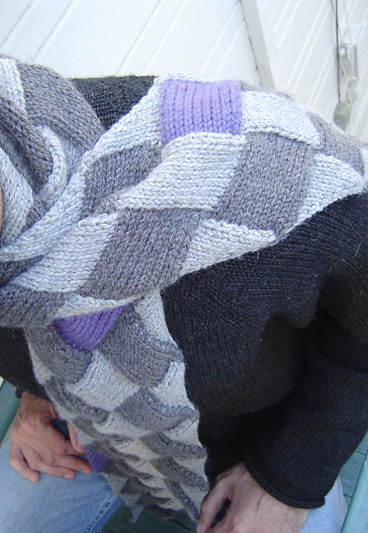
Oh, yeah. Intrelac, baby. I've been wanting to try this skill since I first saw the Danica Scarf.
Isn't she pretty?
I'm not sure why I'm so intimidated by this. According to ravelry, a lot of people have made this scarf, and so it can't possibly be as impossible as it looks. But I hate the idea of seams, and so a whole scarf based on the idea of picking up stitches from the sides of knit sections over and over and over and.... yikes.
Currently trying to stash bust, and I don't have anything appropriate for knitting it currently, but I've decided that as soon as I get back to the point when I am buying yarn, I intend to buy yarn for specific projects instead of on a whim, and this is the first thing I'm buying for. So yeah. Soon.

2KCBWDAY6

Monday, April 4, 2011

Knitting & Crochet Blog Week: Your knitting and crochet time

PROMPT: Write about your typical crafting time.
I am an easily distracted crafter. I only rarely sit quietly and knit without any other kind of entertainment. I listen to music and podcasts, watch tv and movies, sometimes I even read, if I'm knitting pure stockinette or garter stitch. My current favorites are these:
Edward Sharpe and the Magnetic Zeroes
Community
and whatever's on Universal Channel, so I don't have to think about what's going on in a foreign language.
2KCBWDAY5
Related Posts Plugin for WordPress, Blogger...