Monday, July 14, 2008

flickr game


1. Cordial & Miriam, 2. Hot Hummus, 3. Throw Down, 4. a gaggle of olives, 5. Glen Hansard Polaroid, 6. Mojito?, 7. county galway, 8. Peach, Blueberry & Blackberry Cobbler, 9. Authors 1, 10. .endless stillness., 11. anachronistic.jpg, 12. Group in San Diego over New Years


Wanna play?
The concept:
a. Type your answer to each of the questions below into Flickr Search.
b. Using only the first page, pick an image.
c. Copy and paste each of the URLs for the images into fd’s mosaic maker.

The Questions:
1. What is your first name?
2. What is your favorite food?
3. What high school did you go to?
4. What is your favorite color?
5. Who is your celebrity crush?
6. Favorite drink?
7. Dream vacation?
8. Favorite dessert?
9. What you want to be when you grow up?
10. What do you love most in life?
11. One Word to describe you.
12. Your flickr name.


discovered via elsie marley

Saturday, May 10, 2008

alles gute, meiner!

Conrad, one of the Quenzel's sons, turned thirty this week, so today is the big party. This is the moment the whole family has been waiting, for, apparently, b/c it's the debut of the renovations they've been doing in the "garden house." I'm realizing now that I've posted like no pictures of their house. Sorry.

Anyway, basically, their house is one of those that line the city walls, with big front doors to garages and bigger gardens. These were originally built for the city-dwelling peasant class, who needed to pull carriages off the streets, house horses, etc. So, we've got an awesome three-tier back yard - the main "Hof," a terrace, and the garden plot that sits right up next to the city wall and what is now the lowest part of the park. The Quenzels have lived here for a couple hundred years, and the house has taken on a couple different financial endeavors. The house in the garden was built during the time that Louisa had a brewery and bar here. When Christoph's grandfather became a doctor they cut out the brewing, but the house is still there, and has mostly been a workshop/storage space since Ruth and Christoph took over. Originally, they thought that when they got old and one of their children moved into the house they would move out to that second house, but it's fairly impractical since the ground floor doesn't have real living space, and they're worried about not being able to use stairs (although I know very few old Germans that can't tackle stairs), and are now planning on living in the first floor that is currently my apartment. So now, the garden house has become a party house. First Conrad's birthday, then Ruth's (next week), and Phillipp and Marion wanted to have their Polterabend (the party the night before their wedding) there, but have now changed their plans.

Well, I never saw the upstairs of the house before they started fixing it up, b/c it required climbing a scary looking ladder at least 15 feet and then doing a pull-up into the window, but it looks awesome now, and since the building was built just before the civil war, I'm thinkin' they had a lot to do. They built a new external staircase and porch on the back side, and it stays sunny up there until about 21:30 at this time of year, even though it's pretty shady in the garden by 20:00. We've been hanging out up there every evening this week, and tonight I think there's supposed to be 40 people or something coming to the party.

Been a while since I posted a recipe. I've basically been eating the same things over and over, or else I've been out of town and therefore not cooking for myself. SO.... The Quenzels asked me to bring a salad, which is not a big deal except that then they started saying how they're going to tell all the guests it's an American delicacy, and I felt pressured to make something quintessential. I thought about making homemade ranch dressing for a regular tossed salad, but I've never even thought about that before and it seemed like a daunting task. Then this salad was born. The Quenzels really like tex-mex, and I started off thinking about a bean salad because of that. The white limas (which, here at least, don't have that sweet taste the green ones do) take away from that a little, but I was trying to add color and size variation, and I think that although not typical tex-mex, I'm pleased with their addition.

Kat's "Ach, LEUTE!" Bean Salad
1 large can sweet corn
1 large can red kidney beans
1 small can jumbo white lima beans
2 small red onions
juice of 1 small lemon
1/2 head iceberg lettuce
cilantro, white pepper, sunflower oil to taste

Rinse beans and corn thoroughly with cold water. Combine beans, corn, onion, lemon juice, and spices beforehand to give the spice a chance to soak into the veggies (yes, I know beans are legumes but w/e). Let stand one hour. Chop lettuce in strips, wash, and add, with oil, just before serving.

I'll add pictures later, but I haven't made this look especially pretty yet, so I'll take pics of the final product. It's not ready yet b/c the party's not for a couple hours.

Wednesday, May 7, 2008

well crap.

I really did mean to do this more often. But that last post, I have to admit, kind of wore me out. Well, here goes again anyway.

I spent a good deal of time recuperating from the Americans. You know, watching junk tv, knitting, vegging out, the whole deal. And then, suddenly, I realized time was almost up. So I took off. Spring finally came to Germany (in its own little European way), and I was in Berlin when I feel like it finally happened. One of the kids from the youth group here works for a popular German band, Tocotronic, and got me in free to their concert in Potsdam. It was pretty cool, but I'm admittedly not the hugest Tocotronic fan, and so it was also a little awkward. Most of the people there knew all the words, and apparently they're more alternative than I had gathered from their music, b/c although I showed up all cute in my bright yellow dress, everyone else had on black. Exclusively. With the minor exception of the lime green screen print on their just-purchased merch. Nice. Anyway, I was basically there by myself since Katha had to work, but I made friends with a couple guys while I was trying to just find the damn place, and so at least the waiting for the concert wasn't totally lonely (but once the music started, Martin went off to mosh and I stuck to the outsides). I've developed a little bit of claustrophobia, it would seem, and I can't do crowds the way I used to. Maybe it's something about not being certain of how to express panic, but I really need to feel like I always have two ways of walking out of a situation, and that is simply not possible at a concert once people get going.

WARNING: I feel like this post is semi-picture-heavy. But I had a ridiculously hard time deciding which pictures to put up. Please see my flickr page for more.


Anyway, I stayed with Uli (my first-ever host sister from Bavaria) that night, and spent the weekend with her and her roommates. Since I was not really excited about the Berlin I had experienced so far, we decided not to do anything touristy, but rather find something to make me feel like it was a pretty cool place. We ended up in the trendy hipster neighborhood (still can't figure out the name of it?) where everyone was gorgeous and I wanted to buy all the clothes they were selling but couldn't afford the air in those stores. So we ate ice cream and took off, with a quick stop at Sonnenallee, the famous street that ran straight into the Berlin Wall, but weren't sure exactly where the wall was, so didn't exactly get to that point... Oh well. Then we headed back and while Uli baked a cake, I cut Felix's hair with a rusty pair of scissors he found in the back of the kitchen drawer. Brave soul. But he was pleased with the outcome and I'm not too embarrassed to say that I am responsible for it. Saturday night we went to a party that was nothing remarkable.
Sunday I got up and went to the only Quaker Meeting in Germany, which was nice but made me miss my Friends (ha! get it?) in Columbia. Saturday afternoon, we sat up in the park in Uli's neighborhood, Kreuzberg, with a cheesecake, coffee, and no silverware and just... chilled. It was nice. I really liked Uli's roommates, and not just because I miss young people and not living alone. They were genuinely awesome. I was really sad that I had to come back to Eisleben that evening, but it was okay because...

First thing Tuesday I got on a train to Regensburg, and seven hours later I got there, and hung out with my old host parents and Uli's sister, Maria, who I don't think I ever met, honestly, before then. It was nice and Bavarian, but considerably colder than it had been in Berlin which was sad. We went and wandered around downtown Regensburg on Wednesday, and although I confirmed the fact that I do like the city, I don't know if I'd keep it on my top five favorite German cities list anymore. I think I was mostly excited about it that summer I was there because I was seventeen and had never been to Europe and it was big and exciting but not so crowded and touristy as Munich. What I mean is, it's cute, and I could live there probably, but I'd much rather hang out in Erfurt. Then again, maybe I just can't get over how much money they have in Bavaria and Phillipp has been getting to me with his East German propaganda.
[mom and dad, I'm sorry, but I didn't take a single picture of the Schäfers. However, they got these knew "garden gnomes" and I thought you would like them, ma.]

Uh-huh. Well, Thursday I went on a 13 hour train ride to Rome to visit Audra, who lived in Preston with me and is an awesome girl. Her exams started on Monday so it was another laid back weekend, but I did all the main things, some with her - Vatican, Trevi Fountain - and some while she was in class or studying - Coliseum, Palatine Hill, the Parthenon. My general feeling on Rome, however, was indifference. The phrase that kept coming to my mind was "TOO MUCH!" There was so much stuff to see, but Rome is infuriating with its lack of explanations. Even though almost everyone who works anywhere public in Rome speaks English, all the museums were exclusively in Italian, and there are few directional signs for the major events. Don't even get me started on the way everything is built like a maze that has no right or wrong directions, so that you can wander and wander and have no idea where you are until you think "I've been here before," but don't know which way you left so you don't know where to go this time. I liked Palatine Hill, mostly because it was largely an outdoor park and I have gotten to where I really like places where people lay around in the grass, but I apparently missed an archaeological dig site b/c it was Roman and confusing and I didn't know there was a way into that part. But the Coliseum is significantly more impressive from the outside (except, of course, for the idea that people stood there so long ago - but that's true of the whole damn city), the Vatican Museum looked like some grandma had shoved as many of her trinkets into one room as possible, even though they rarely made sense next to each other (and I was so frustrated that we waited 4 hours and paid 8euros for the damn thing with so few actual important pieces of art that were usually hidden behind some other, equally old but significantly less well-known), and the Sistine Chapel was over crowded and smelly and even though they obviously don't use the space for worship anymore - it's an empty room with an undressed altar - they kept trying to make people be quiet. What for? So everyone can hear themselves think, "That's it?" in their own heads instead of letting them say it out loud? Alright Vatican City, you got me on St. Peter's Basillica. I don't think I had my mouth closed the whole half hour we were in there. It's huge and ornate and oh so catholic, which is only a little sad because the Pieta gets lost because of its simplicity (it, too, was smaller than I imagined). But my all-time favorite thing there was what Audra and her friends had decided they weren't going to go see at all - the Mouth of Truth. Old movie fans will definitely know it from the Hepburn film Roman Holiday. It's basically an old stone tablet with a giant face on it, the mouth and eyes of which are holes. Legend has it that anyone who lies with their hand in the mouth will have it bitten off by the stone jaws, but either my skin is green or it's not true. So that was a cool thing to see, a little more off the beaten path, but then the exit takes you through the church, which has the relics of St. Valentine, and it's just a cute, smaller chapel that looks, unfortunately, like all the money got spent on the cathedrals. The frescoes around the tops of the walls were in disrepair, the ceiling was raw and didn't look like it was very well taken care of. But something about it was more real than the rest of the city. Then, of course, they went and proved me wrong by putting a souvenir shop in the damn corner. Whatevs. I had a good time being with Audra, reliving the good ole days of Preston gossip and politics and eating gelato (every day! shh...). But now I miss that place and those people more than ever.

I signed my contract for Border Servant Corps today, though, so hopefully that roommate situation will work out as a good substitute for being on campus. I'm starting to get really excited about being out there - I found a couple forums and such, and have been getting good tips on yarn shops, book stores, and farmer's markets. There's if not two at least one Quaker Meeting, and I simply cannot express my excitement about that, and three Jazzercise centers. I can't stand myself.

Well, I've got less than two weeks here now. The only place I haven't gotten to travel to that I thought would is Prague, but Franzi can't go, and I don't think I want to go alone. People keep telling me to just suck it up and go alone, but I don't want it to be a half-ass experience because I'm by myself. Also, maybe it'll be more incentive to come back if I don't make it there. I'm also quite simply worn out from spending the last two weeks on the road, and there are several parties going on here, so I think I'm just going to hang out in Eisleben until it's time to go home, unless I run to Köthen one more time. Because I thought I would see Franzi again, I didn't really feel like I said goodbye to them, and I didn't even see most of my other friends last time I was there because I decided so last minute and they were all out of town. hmm...

Anyway, I will probably post again early next week since this weekend should be exciting, but if not it'll most likely be when I get home...

Saturday, April 12, 2008

buchenwald, die welle, and american schools.

I apologize in advance if I assume you know a lot less than you do. As you see, a lot of the emotion going into this post is frustration, specifically directed at the American educational system. Knowing that people reading this didn't learn German [which is really the only reason I know any German history], didn't study history, or grew up during DDR-times when little information was coming out of this place, I may end up over-informing.

Everyone knows about the famous "Work will make you free" inscription that was over the front gate to many concentration camps (most famously at Auschwitz-Birkenau and Dachau). I was still shocked, however, to see this at the front gate of Buchenwald:A literal translation? "To each his own." Conversational meaning in German? "Everyone gets that which he deserves." This seems so much crueler, somehow, than that infamous promise of freedom. Remember that the prisoners at Buchenwald were not so literally marched to their deaths as was true at some of the more well-known camps. These were mostly political prisoners, sometimes given menial jobs, but mostly left to freeze, to starve, to rot in the middle of the woods near the single most important cultural capital of the German people. A simple google search of this phrase, and you'll also learn that this was the state motto of the Prussian empire. Although it was a part of the Holy Roman Empire*, Prussia was really the first attempt to unite the "German" people, and had (approximately) the current borders on the west side, but also included Denmark, and reached up along the Baltic Sea through most of current day Poland and. That is, that's how far it spread before Hitler started marching all over the place. So, then, what does this mean? Is it a political statement? Some kind of call to return to the past? Or is it really as backhanded as it seems - a command to shut the hell up? I'm not certain...

The whole time we were in Buchenwald, I kept thinking over and over: why didn't anyone stop this? I mean, even of people didn't want to see it themselves (and that I totally understand), doesn't there come a time when the desire to look away is overcome by the knowledge that another human being is suffering? Of course, there's a well-known poem (with many many variations) to this effect, from Martin Niemöller:

When the Nazis came for the Communists,
I remained silent;
I wasn't a Communist.

When they locked up the Social Democrats,
I remained silent;
I wasn't a Social Democrat.

When they came for the trade unionists,
I didn't protest;
I wasn't a trade unionist.

When they came for the Jews,
I remained silent;
I wasn't a Jew.

And when they came for me,
There was no one left to speak out.
Regardless of what people then did or didn't do, the monument that finally knocked some sense into me (which I couldn't get a good photo of, but Zach might've?) reads: "So that the generation to come might know, the children, yet to be born, that they too may rise and declare to their children" (Psalm 78:6).** It hit me that I was somehow lucky to be able to see this. Too many Americans will never be able to go there and to look at those spaces where people suffered and died. Too many kids don't hear about the Holocaust (let alone all the things the Soviets did at Buchenwald) save for one week in the year during history class - that if they're lucky, too. My overwhelming sense is that we want too badly to be the heroes of history. The version of WWII that's most popular seems to be Oh, yeah, they were doing some fighting over there in Europe, but we marched in and put an end to all that crap. God Bless America, right?! God forbid we discuss the massive numbers of Russians that died during that giant mess, so that we might look like heroes. And then what of Mussolini and Stalin? Why is Hitler the only example we're given, when he is not the only face of fascism? Why were the events at Abu Ghraib laughed off and then so easily forgotten? What isn't my government telling me about what happens at Gitmo, and why, exactly, are they so opposed to me traveling to Cuba (don't give me that crap about economic embargo. I'm not buyin' it.)?
Monument for women and girls: No one took their goodbye. No one erected a cross or a stone. But you shall live, as long as people keep your memory. [my translation]

And then, of course, German film... Oh, will you never tire of capturing all the scary, scary things that happen in America? [I hope not]

When I was in Köthen, Jan gave me a bunch of movies to watch. He said it was homework, that these were the things I needed to know about Germany. Admittedly, Jan had a very particular view of what was important about his culture, and a lot of his slant could be attributed to the fact that he worked/works for the German Army. So I watched a lot of movies about Nazis and Punks and being in prison and getting in knife fights. It was exciting. One, in particular, that struck me was Das Experiment. You might've seen it, actually, under the title The Experiment. It was subtitled and released on video, if not run through theaters. It was based on a Stanford U experiment about power, authority, and the sociology of prison interactions. 24 men were paid to take part in a mock-prison situation, randomly assigned as either prisoners or jail keepers, and given minimal supervision. Essentially, things got way out of hand, and the proposed 14-day experiment was called off after only 6 days. Hmm. Stanford University. That's a respectable place with intelligent people. And yet, they allowed men to humiliate and torture each other for six days. Had you heard of it? I hadn't. But every high schooler in Germany learns about the experiment, as well as many of the investigator's buddies' experiments, in their Social Studies classes. Even though it happened in AMERICA - not here.

Take two: Die Welle. Read about this one in the newspaper. It's a German movie with German actors that plays out in Germany, but it's baed on an American high school teacher (Ron Jones) in Palo Alto, California who put his history class to an experiment based on the premise that the Holocaust would never happen in America. People wouldn't go along with the Party, was the claim. And yet, the students created their own Party (the Third Wave), uniform, salute, icon, manner of behavior (including being drilled on entering the classroom quickly and silently), and followed their teacher like good little Hitlerjugend within three days. Heard of it? Nope, me either. There's a movie about it - made in America in 81 but apparently swept under the carpet - and a book, which most German high schoolers read, naturally. Fair enough, I'm sure German kids are sick and tired of hearing about all the awful things their grandparents allowed to happen more than 50 years ago. I get that. In fact, Die Welle did an excellent job of addressing that boredom; at the start of the conversation, which is prompted in the film by a project week on forms of government, one student says, "I'm sick of these damn Nazis. Autocracy. Fine. Can't we talk about the Bush Administration?" Hmm. The Bush Administration, you say. I dare you to find a cross-section of American high school students who would be able identify the ways in which the current government could be considered autocratic or fascist. Anyone think that has anything to do with the fact that we don't talk about autocracy or fascism, or even what real democracy might look like - psst. here's a hint: America's not one! I cannot believe our inability to be honest with ourselves. The first steps to recognizing and putting an end to unhealthy government policies is learning about past mistakes. Allowing a majority of citizens to be and remain disenfranchised, struggling, and hungry, on the other hand, sounds like a fast-track to fascism to me.

Well, this has gone on long enough. Sorry for the rant.

Hearing: Ben Harper.
Reading: Lessons for next week (practicing, really, more than reading...)
Making: Intrelac scarf from baby alpaca yarn.

*PC, remember when I said things in Weimar looked Prussian, and not German? What I couldn't figure out how to articulate then rests here. Prussia was essentially Roman, and not "purely German."
**Without being able to read the Hebrew version, the feeling of the German text on this monument had a different feel to me. Naturally, they used some translation of the bible that they felt was fitting and accurate to the original text, but it was the German that struck me. I would translate it like this: "So that the Generation to come, all the children yet to be born, they too will stand and tell this to their children."


PS. I know, Zach, I know... Just... save it.

Thursday, April 10, 2008

photography

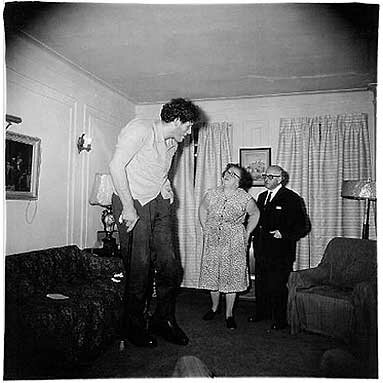
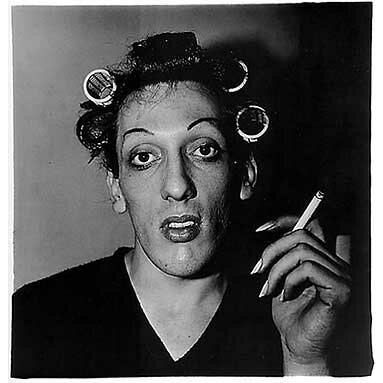
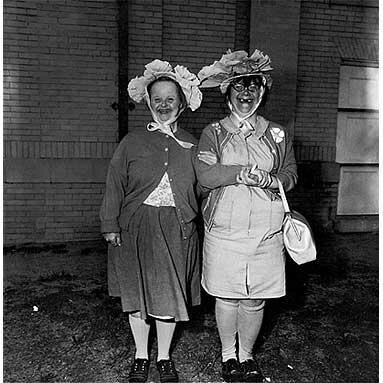
I discovered two photographers today that I love: Albrecht Tübke and Diane Arbus. Both are "street photographers," meaning their subjects are just every day people, not models. Tübke's are also German, so of course they hold a special place in my heart. Some of my favorite examples: They have such awesome attitudes about them. I don't know if Tübke is just good at spotting attitude or if he poses them (I really hope not but I suspect so, since many have similar postures) but they all look like they think they're the shit.
Of course, this woman actually is:I want to model my entire wardrobe after this photo.

I'm no expert on photography, so all I can do is go with the stuff I read, which cites Arbus as a predecessor of this style. However, Arbus became best known for photographing "outsiders" in the middle of the 1900s:
Her unrelentingly direct photographs of people who live on the edge of societal acceptance, as well as those photographs depicting supposedly "normal" people in a way that sharply outlines the cracks in their public masks, were controversial at the time of their creation and remain so today....
Arbus's pictures are almost invariably confrontational: the subjects look directly at the camera and are sharply rendered, lit by direct flash or other frontal lighting. Her subjects appear to be perfectly willing, if not eager, to reveal themselves and their flaws to her lens.
She said of her pictures, "What I'm trying to describe is that it's impossible to get out of your skin into somebody else's.... That somebody else's tragedy is not the same as your own." And of her subjects who were physically unusual, she said, "Most people go through life dreading they'll have a traumatic experience. [These people] were born with their trauma. They've already passed their test in life. They're aristocrats." artphotogallery.org

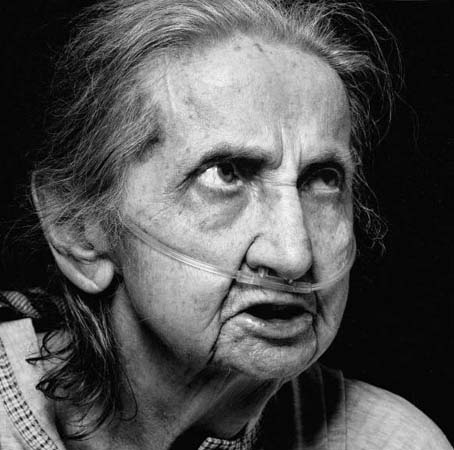
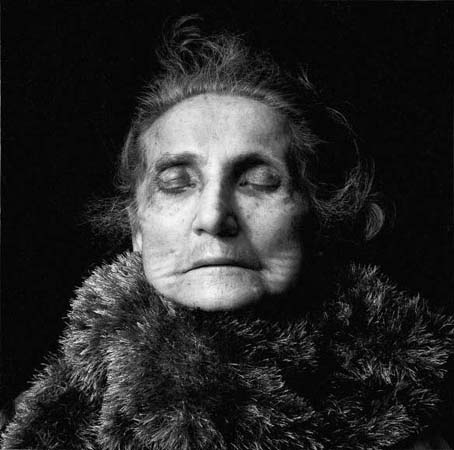
Alright, make that three. Shortly after I started writing this entry, I checked facebook, and one of the things on my news feed was that Tamera had posted a link to the Wellcome Collection, a series of photos taken of people shortly before and then just after their deaths. Quite different, but also striking.

Tübke photos via http://www.tuebke.info/
Arbus photos via http://www.artphotogallery.org/02/artphotogallery/photographers/diane_arbus_01.html
[discovery via bits and bobbins.]

Wednesday, April 2, 2008

oh yeah.

I actually did cook a tiny bit while the groups were here... One recipe doesn't have a picture, though, and the other one came out gritty and grey. Sorry.

Mexican Tortellini
1 portion tortellini
1 can black beans
1 can sweet corn
1 small tomato
2 tsp cilantro

Cook pasta, drain. Warm beans, tomato, and cilantro over medium heat. Add corn but do not heat. Serve with sour cream, cheddar cheese, and salsa.
***

Indian Tuna Casserole
1 1/2 cups cooked pasta, any kind
1 can tuna in water
1 small can sweet corn, drained
1/2 small can sliced mushrooms, drained
2 cups light sour cream
2 slices Gouda cheese
curry powder, to taste

Cook pasta, drain. Fluff tuna with fork and add to pasta. (I decided to mix up the tuna and pasta before adding anything with liquid that would make the tuna sticky and clumpy again. If you like big ole chunks of tuna, skip this step.) Add vegetables and sour cream and stir over low heat. Add curry powder until sauce is just slightly yellow. Place cheese on top and bake for 25 minutes at 100*C.

Whatever. Not like you're gunna cook it anyway.

phew.

Well, that was exciting.

All the groups are home (more or less without incident), I'm back in Eisleben for a quiet little week of recuperation, and spring has come! [knock on wood]. Yep, that's right, although it snowed less than two weeks ago, I've been running around in shirt sleeves and skirts for the last three days. Well, running around may be an exaggeration. I've been wearing them. I haven't been running anywhere, and really haven't left my apartment much except to fraternize with my host family in the garden. I can't tell you how excited I am. I'm a little mad at myself for not sending more of my bulky warm clothes home with my parents, but whatever. It's like, 12*C!! Good times.

Hokay... Catch up.

Erfurt is pretty much my favorite place on earth right now. Alright, that's an exaggeration, but it was the only place I got to breathe for the last month, and so I have a little bit of an attachment. It's also just a cool place - big enough that stuff is going on, but very laid-back at the same time. Additionally, it has the best street art/graffiti I've ever seen. I actually "collected" it, it was so cool. Dang, I need to get that up on flickr.

With the UniLu group I got to go to Weimar, a place that everyone in this region raves about. It's been a center of German culture, art, and intellectual thought for a long long time, and in many ways is considered the "heart" of Germany. Buchenwald, a Nazi and later Soviet work camp, is just outside the city walls, which means less to us, maybe, than it does to Germans. It was a shock to many people, after the war, that such a thing was happening so close to an important city. In reality, much of that shock was probably about being forced to look at the things they had been ignoring for such a long time, and its proximity to Weimar was just the salt in the wound. Buchenwald was not a death camp in the way that Auschwitz was, and housed more political prisoners and dissidents (including Ernst Thälman and Dietrich Bonhoeffer; Elie Wiesel was also here, but not because of politics) and than Jews. I feel I need to write much, much more about the experience of going there, but it may be better suited for another post.

I finally got to spend an afternoon in Berlin, again with UniLu, but I still haven't gotten to see the things I wanted to go back for. Mostly, right now, I want to go to the Käthe Kollwitz Museum. But of course I still have time.

Travel plans: Prague/Dresden and Italy are pretty much certain, but I need to talk to Franzi and Jon about when. I could go to Sweeden with some people from the JG and Scott, but I don't really have any particular interest in going, and I think I'd rather spend my money seeing something I'm dying to see. Will invited me to Spain, but that'll be a matter of when he could host me. I'm currently toying with the idea of going to Barcelona and Paris, then to Ireland, and flying back. Dang I wanna go to Ireland so bad. Problem is that I don't know anyone there, and I really don't want to go by myself.

The job with BSC is definite. I'll be getting my contract in the mail soon, and then I suppose it'll be time to look for a plane ticket? Man, that's weird. I may have mentioned before that I have a Rosetta Stone program for Latin American Spanish, or maybe not. Either way, I do have one, and I've been feverishly trying to learn enough phrases to not sound like an ass when I show up on the border. It's coming along, only very very slowly.

Anyway, I've decided to stay home for the summer, unless something pretty serious changes. It's just too expensive to fly back here for two more months of wasting my time. If I'm in the states, I don't have to pay rent, I could maybe earn some money, and at the very least, I'm blessed with friends who enjoy having fun for free, something that doesn't work out real well here. Best case scenario, I can split my time between the mountains and the beach and I won't get sunburned too bad. Also, re-acclimating to heat is sounding pretty pretty good right now. The prospect of leaving 18*C for a desert is not so great if you ask me.
Related Posts Plugin for WordPress, Blogger...